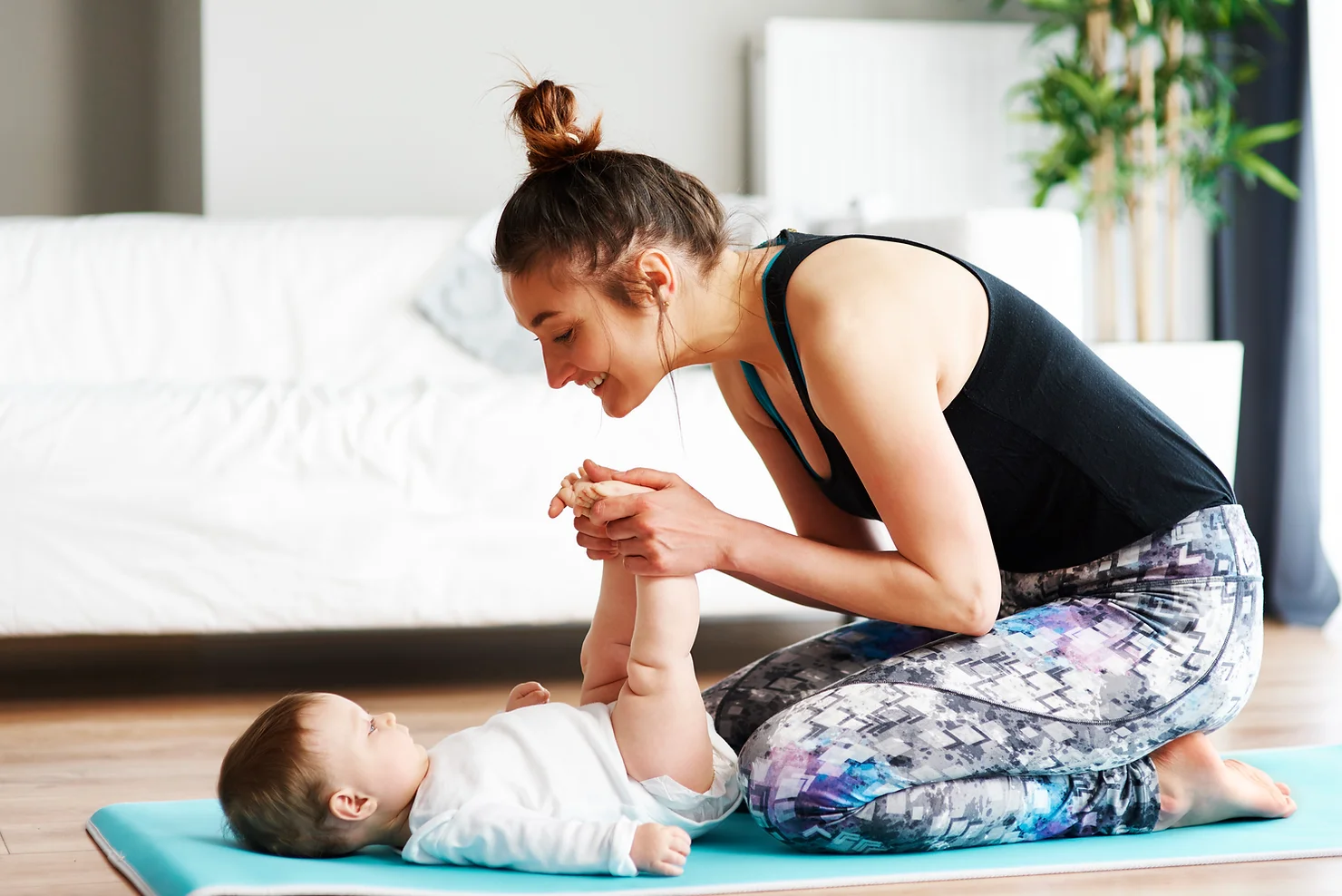
Between 5 and 7 months your baby is becoming a mobile explorer, and the best activities for a 5 month old are short, simple and repeatable: tummy time, reaching for toys just out of range, peekaboo, and lots of talking. Ten minutes at a time is plenty. You do not need special equipment, and you do not need to fill the day.
This is the stage where babies start reaching, grabbing and rolling with real intent. Play is how they practice those skills, and it is also how they wind down enough to sleep well at night.
What can a 5 to 7 month old baby actually do?
Most babies in this window are working on rolling in both directions, sitting with support and then briefly without it, reaching deliberately for objects, and passing things from one hand to the other. Many are babbling with consonant sounds.
Every baby arrives at these at a different point. Treat the activities below as an invitation rather than a checklist. If your baby is not interested in something today, offer it again next week.
If your baby is at the younger end of this range, our playtime activities for your 0 to 3 month old and activities with a 4 month old cover the stage just before this one.
What activities help physical development at this age?
These build the neck, shoulder, back and leg strength your baby needs for crawling and, eventually, walking.
Tummy time. Still the single most useful thing you can do. Place toys just out of reach to encourage stretching and movement. A playmat with contrasting colors, textures and crinkly elements keeps it interesting for longer, which matters when your baby protests after two minutes.
Sitting practice. Support your baby in a seated position with pillows, or hold them upright. This develops the core strength and balance that independent sitting needs.
Rolling. Place a favorite toy to one side, just beyond reach. Reaching across the body is what triggers the roll.
Standing support. Hold your baby under the arms and let them bear weight through their legs. Short bursts build leg strength and get them used to the sensation.
Baby exercises. Gently cycle their legs as if pedaling. It is a good way to fill a diaper change and babies often find it funny.
What activities support brain development?
Peekaboo. The classic, and it is doing real work. Peekaboo teaches object permanence, the understanding that things still exist when they cannot be seen. This is also why it becomes hilarious at this age.
Simple puzzles. Large wooden puzzles with chunky, easy-to-grasp handles. Your baby will not solve them yet, but handling the pieces builds problem-solving and fine motor control.
Exploration toys. Anything that responds: rattles that make noise, toys with different textures, buttons that light up when pressed. Cause and effect is the lesson.
Bubble play. Blow bubbles and let your baby watch them drift and pop. Excellent for eye tracking, and reliably mesmerising.
Books. Board books with bright pictures and very simple text. You are not reading for the story yet, you are reading for the voice, the rhythm and the pictures.
How do I help my baby's senses develop?
Texture exploration. Offer soft, crinkly, bumpy and smooth objects. Tactile variety is what builds the sensory map.
Sound exploration. Musical toys, rattles and shakers introduce different sounds and help coordination as your baby learns to make the sound happen on purpose.
Water play. Supervised play in a small tub, or bath toys at bath time. Warm water is both stimulating and calming, which makes it useful in the evening.
Music and dance. Play different kinds of music and move your baby's hands and legs in rhythm. Good for auditory processing and for your own mood at 5pm.
Outdoor strolls. New sights, sounds and smells, with no effort required from you. A walk counts as sensory play.
How do I encourage my baby to start talking?
Talk and sing constantly. Narrate what you are doing and name the objects around you. Vocabulary is built from hearing words in context long before your baby uses them.
Nursery rhymes with gestures. The combination of rhythm, repetition and movement supports language and pattern recognition.
Interactive books. Flaps and textures give your baby something to do while you read, which keeps them engaged for longer.
What builds fine motor skills at 5 to 7 months?
Grasping and reaching. Rings, soft blocks and stacking cups are all good. Hold a toy just out of reach so your baby has to stretch for it.
Transferring toys. Encourage passing an object from one hand to the other. This is bilateral coordination, and it is a genuine milestone.
Soft block play. Stacking and, far more importantly, knocking down. Hand-eye coordination plus cause and effect.
Push and pull toys. Anything that moves when your baby acts on it encourages movement and coordination.
How long should playtime last?
Short bursts. Ten to fifteen minutes of focused play at a time is plenty for this age, and several short sessions beat one long one.
Watch for the cues that your baby has had enough: turning away, arching, fussing, losing interest in a toy they were enjoying a minute ago. Overstimulation at this age tips into overtiredness quickly, and an overtired baby is harder to settle.
Rotate activities rather than offering everything at once. A small selection that changes is more engaging than a large selection that does not.
Does daytime play actually help night sleep?
Yes, in two ways. Physical activity during the day helps your baby use their energy and build the strength that lets them settle comfortably. And a day with enough stimulation, spaced by proper naps, makes bedtime easier than a day that was either too empty or too busy.
The balance matters more than the total. If you are unsure how much awake time your baby should be having between naps, our guide to wake windows by age sets out the ranges.
Once your baby is crawling and pulling up, the activities change again. Our playtime activities for your 8-10 month old picks up from here.
How do I keep playtime safe?
Supervise all play. Check that toys are age-appropriate, with no small parts, and that anything your baby can reach is safe to put in their mouth, because it will go in their mouth. Never leave your baby unattended during water play, even in very shallow water.
FAQ
What toys are best for a 5 month old?
Simple, responsive and safe to mouth. Rattles, soft blocks, stacking cups, board books, a baby-safe mirror and a textured playmat cover almost everything a baby this age needs. Toys that react when your baby acts on them are more valuable than toys that entertain on their own.
My baby is not rolling yet. Should I be worried?
Usually not. Rolling commonly appears anywhere between 4 and 7 months, and babies often master one direction well before the other. If your baby is not rolling at all by around 7 months, or is not bearing any weight on their legs, mention it at your next check-up.
Can too much play affect sleep?
It can. Overstimulation late in the day makes settling harder. Keep the livelier activities for earlier and shift toward calmer, quieter play in the hour before bed.
How many activities should I do in a day?
There is no target. A few short sessions between naps is plenty, and plenty of babies get most of their stimulation simply from being carried around while you go about your day.
Do I need to buy special toys?
No. Household objects with interesting textures and sounds, your own face and voice, and a safe floor to move on will do most of the work at this age.
Sources
- American Academy of Pediatrics. (2021). Movement Milestones: Babies 4 to 7 Months
- American Academy of Pediatrics. (2023). Cognitive Development in Infants: 4 to 7 Months
- American Academy of Pediatrics. (2009). Language Development: 4 to 7 Months
- American Academy of Pediatrics. (2026). Infant Drowning Prevention and Water Safety: How to Protect Your Baby
- Centers for Disease Control and Prevention. (2026). Milestones by 6 Months
- Hewitt, L., Kerr, E., Stanley, R. M., and Okely, A. D. (2020). Tummy Time and Infant Health Outcomes: A Systematic Review